Growing Livelihood Opportunities for Women
Roadmap to Improve Gender Equity for Food and Beverage (F&B) Services Companies
Industry Overview
Food and Beverage (F&B) services industry includes F&B outlets (e.g., casual dining restaurants, fine dining restaurants, quick service restaurants, pubs, cloud kitchens) and catering services (e.g., canteens, in-flight meal providers). As of 2025, the F&B services industry employs approximately 12 million workers[1], and headcount is expected to grow at 5% CAGR to approximately 14 million by 2028.[2] This growth is driven by rising disposable incomes, shifting consumer preferences towards more frequent dining out, and accelerating service innovations such as restaurant aggregators and delivery-only brands.Why should F&B services companies aim to improve gender equity in entry-level roles?[3]
Hiring more women in entry-level roles can:- Improve customer experience (e.g., higher satisfaction amongst customers)
- Improve work quality (e.g., better hygiene and cleanliness at workplace)
- Improve work culture (e.g., fewer workplace malpractices)
Why do F&B services companies have low gender equity in entry-level roles today?[4]
Company-level challenges- Managers perceive kitchen roles as inappropriate for women due to heavy lifting, fast-paced work, high-heat and potential resistance to authority from men
- Managers perceive roles in dining restaurants as inappropriate for women due to long shifts and male-dominated work environments
- Managers are reluctant to hire women in shifts ending late evening (post~7-8 PM) due to safety concerns
- Brands and franchisees place limited priority on gender diversity
- Skilling/ training programs for culinary/ chef roles have low gender diversity
- Some laws (e.g., mandatory pick-up and drop for night shifts) make women uncompetitive in the labour market
- Some states disallow women from working in alcohol-serving outlets
- Cities/ towns, especially suburbs or during late hours, lack affordable and safe transport facilities
Where is the opportunity to add more women in F&B services industry?[4]
F&B outlets account for over 80% of the F&B services industry workforce but have only 21% gender diversity. Many entry-level kitchen and non-kitchen roles (e.g., barista, waiter, cook, steward) are suitable for non-graduate women. F&B outlets have high potential for employing more women in these roles across three segments:- Quick service restaurants (QSRs) can add more women in afternoon/ evening shifts, where gender diversity is <10% compared with 35-50% in morning/ day shifts
- Dining restaurants (fine dining and casual dining) can add women across roles, as gender diversity is currently <10% in kitchen roles and <20% in non-kitchen roles
- Cloud kitchens, pubs/ bars, and central kitchens (e.g., used for event catering) have potential to employ women across all roles
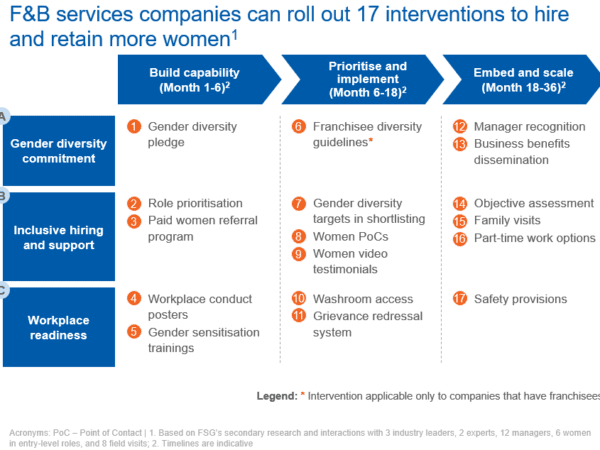
How can F&B services companies make entry-level roles more gender-equitable?[4]
- Build the organisation’s capability (1-6 months): Establish the foundation by setting a company-level gender diversity target and sensitising employees through workplace conduct posters and trainings
- Prioritise and implement (6-18 months): Ensure sustained focus by incorporating diversity guidelines in franchisee contracts, adopting inclusive hiring practices (e.g., gender diversity targets in shortlisting), and setting up grievance redressal systems
- Embed and scale (18-36 months): Institutionalise gender diversity by recognising managers with gender-diverse teams, disseminating business benefits, and strengthening support for women workers via part-time work options and safety provisions
How can F&B services companies track their progress on gender equity?
The Gender Equity Readiness Scorecard (GERS) is an open-source tool which offers a quick, objective assessment of gender equity within a company. The F&B GERS tool evaluates progress on gender equity across four dimensions – outcome, awareness and accountability, workplace practices, and infrastructure. F&B services companies can use the GERS tool to get a clear, objective baseline of their performance on gender equity in entry-level roles, identify the next set of practices to implement, and track progress over time. Ecosystem players (e.g., governments, funders) can leverage the GERS to nudge companies to prioritise gender equity, benchmark companies on their performance, identify emerging trends and challenges, and prioritise specific incentives/ programs for improving gender equity in the industry.To start your gender diversity journey, download the gender equity roadmap >
To access the GERS excel tool, click here >
If you want support implementing this roadmap, email us at GLOW@fsg.org >
[1] Annual PLFS report 2025
[3] FSG’s secondary research, interactions with industry stakeholders, and digital survey with 58 managers across industries
[4] FSG’s secondary research and interactions with 3 industry leaders, 2 experts, 12 managers, 6 women in entry-level roles, and 8 field visits